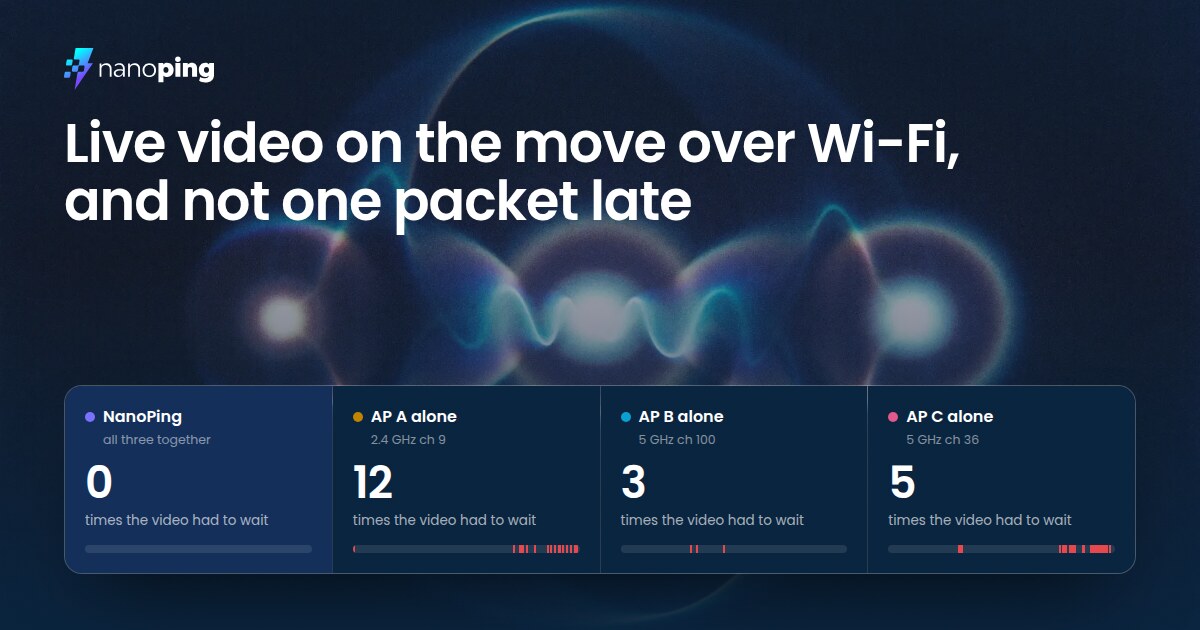
We carried a laptop through a 30 m lab that no single Wi-Fi access point covers, sending live video the whole minute. On its own, each of the three networks got too slow as the laptop walked away from it. With NanoPing using all three at once, every packet arrived within 100 ms.
The same laptop, the same walk and the same minute. NanoPing used all three networks at once. Each network on its own is worked out from how it handled the packets NanoPing sent over it. Even the best of them, AP B, would have spoiled 8 frames. On every line, lower is better.
One walk; a check marks the best on the line. A network on its own counts as too slow in any tenth of a second in which a packet NanoPing sent over it arrived after 100 ms or never, or the laptop had no connection to it. Moments less than half a second apart count as one time. Frames: a frame counts as late or lost on a network if a packet sent over it during that frame was.