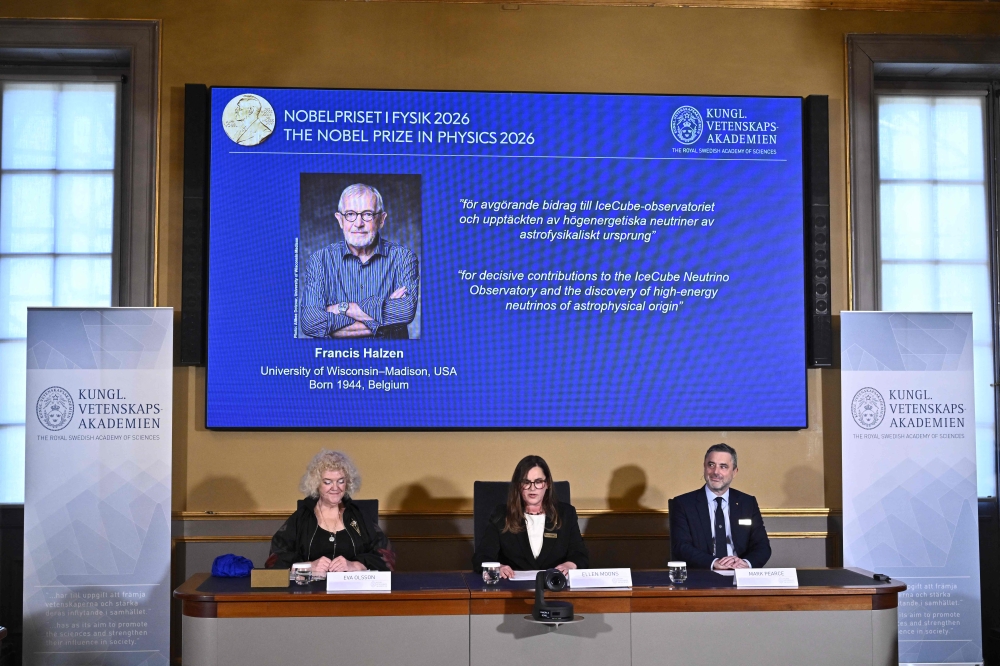
STOCKHOLM, Oct 6 — Belgian physicist Francis Halzen on Tuesday won the Nobel physics prize for groundbreaking work using South Pole ice to capture neutrinos originating in the distant cosmos, providing insight into the far reaches of space.
“This year’s prize is about ghostly messengers from space,” Ellen Moons, secretary general of the Royal Swedish Academy of Sciences, told a news conference.
Halzen was honoured “for decisive contributions to the IceCube Neutrino Observatory and the discovery of high-energy neutrinos of astrophysical origin”, the jury said.
The Royal Swedish Academy of Sciences said Halzen’s work had been fundamental for the observatory – “a cubic kilometre of ice that is equipped with light sensors” – and has “paved the way for a new kind of astronomy”.